
Intel's next-generation CPU architecture - Conroe, Merom and Woodcrest
How times have changed for Intel - For so long unrivalled king of the hill in the PC CPU world, the last couple of years have seen quite a turnaround in the mindset of the enthusiast community. Intel bet the shop on the NetBurst architecture which powers the Pentium 4, expecting it to take them all the way up to 10GHz on the clock speed scale.
Of course, we all now know the true face of NetBurst - Initially, the Pentium 4 disappointed by failing to convince against its own predecessor, the Pentium 3. Then came the Northwood core, and things were looking up, until AMD delivered a body blow in the form of the Athlon 64, which managed to offer both a compelling, exciting feature set (64-bit support and an integrated, on-die memory controller being the highlights) coupled with excellent performance and superior IPC (Instructions Per Clock) which, quite frankly, blew Intel's best efforts out of the water.
Since then, AMD have gone from strength to strength, matching and bettering what little ammunition Intel had to throw at them. When Intel upped clock speeds, so did AMD. When Intel brought out a top-of-the-range enthusiast line, AMD already had their own. When Intel went dual-core, so did AMD.
Indeed, if anything things have gotten worse still for Intel in the past twelve months. The follow on from their Northwood core, Prescott, is in many senses not far short of a disaster, proving to be ridiculously hot and having little in the way of clock speed gains to show for its increase to a whopping 31 pipeline stages. The final ignominy was when Intel announced they were scrapping plans to bring a 4GHz Prescott-based core to market, proving that NetBurst was, in many ways, dead in the water.
With all of this in mind, it's not really surprising that Intel's Fall 2005 Developer Forum brought forth the announcement of development of a new generation of CPUs from Intel. Is this series of new cores going to be the answer to Intel's problems?
What's new in this architecture?
From talking about the problems Intel have suffered with their NetBurst architecture, it will surprise few to hear that this new architecture (Which has no name of its own at this juncture) aims to rectify those issues. Namely, Intel's next-generation CPUs are going to focus far more on performance per watt, in other words looking to lower power consumption while offering the best possible performance. So, how is Intel going to go about achieving this?
To start with, we should probably look at the elements of the current Pentium 4 architecture which will remain. First up, dual-core will, naturally, still be in the equation, although some elements (namely cache) will be handled in a slightly different fashion. 64-bit support will also unsurprisingly find its way into this new architecture, as will support for the same bus speeds as the current Pentium 4 (1066MHz in other words, Intel have shown no desire to move beyond this at present). Finally, these new designs will retain the Out of Order execution core first seen in the Pentium 4.
One thing conspicuous by its absence in this new architecture is HyperThreading - Although it hasn't been confirmed that this is now completely off Intel's roadmap, it certainly looks like it won't be appearing in any of Intel's initial CPUs based around this design.
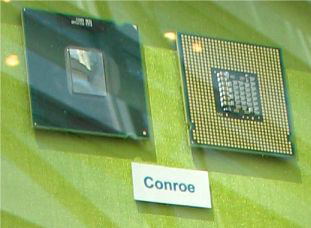
Intel's next-generation desktop CPU - Conroe
Much of the changes between NetBurst and this new architecture can be traced in some way, shape or form back to Intel's recent mobile architecture, Banias. First and foremost, Intel will be moving away from the massive number of pipeline stages seen in the Pentium 4, in favour or less stages as seen in Intel's mobile CPUs (and indeed the Athlon 64). While increasing the number of pipeline stages can help to increase clock speed, it comes at the cost of increased power consumption and heat, as well as a reduced performance - All undesirable factors, particularly if it doesn't allow for massive clock speed gains as we saw with Prescott. With this in mind, Intel's next-generation architecture will feature 14 pipeline stages, compared to the 12 stages which can be found on existing Athlon 64 designs. This should improve performance considerably alone; although the side effect of this is that we most likely still won't be seeing a 4GHz CPU from Intel any time soon.
Intel have also decided to widen the processing ability of this new architecture, by giving it 4-issue capabilities and deeper buffers, compared to the dual-issue abilities of the Pentium 4 core. Put very simply, this means that the new architecture should have increased parallelism and be able to handle the decoding and executing of more instructions simultaneously than the Pentium 4 was capable of.
Another focus for Intel has been improving performance for the aforementioned Out of Order execution properties of the design, specifically in the field of memory access. Intel has implemented a feature called Memory Disambiguation in this area, which is basically there to help with scheduling and general improvements in memory access efficiency.
Of course, how these changes will translate into real-world performance is impossible to say, and we won't know for sure for quite some time, but if you feel like taking what Intel are saying with any more than a pinch of salt, then we should expect 5x the performance per watt of power used from these new CPUs.
Dual core changes
With the amount of marketing effort both Intel and AMD have put into dual-core CPUs, I'm sure it will come as no surprise to any of you to hear that both the desktop and mobile (Conroe and Merom respectively) variants of this new architecture will be designed as dual-core processors. Again, Intel have looked at making improvements over their initial dual-core implementation, which was far more a case of simply sticking two cores side-by-side on the same die.
The main change to Intel's new architecture from a dual core point of view is with regard to cache - The two cores will now share a single set of Level 2 cache between them. This will also most likely facilitate an increase in bandwidth between the cores and cache. Level 1 cache on each core also gets a new system to transfer data directly between the cache featured on each core to help performance, a weak point on Intel's current dual-core designs, as well as other features to improve L1 cache performance and pre-fetching.
When will we see these new designs?
The easiest way to answer this question is to simply take a look at Intel's own roadmap. At present, Intel are planning on bringing Conroe, Merom and Woodcrest-based cores to the market some time in the second half of 2006.
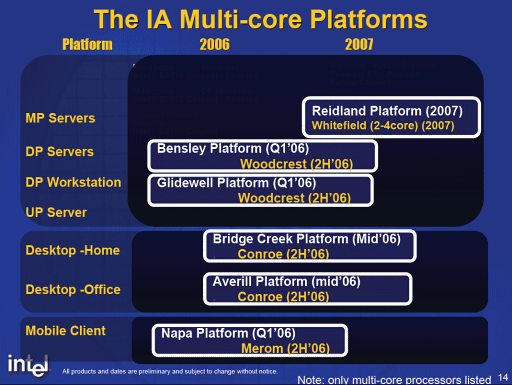
Intel's current CPU and chipset roadmap
As you should be able to fathom from this roadmap, Conroe is the codename of the first desktop variant of CPUs to utilise this new architecture, with Merom taking up the mobile sector and Woodcrest battling it out in the server marker.
Conclusions
I'm sure it goes without saying that making any real conclusions about an architecture we won't be seeing in the flesh for another year based around some sparse explanations of its functionality would be ridiculous in the extreme. It's going to be quite some time before we can even begin to start building a real picture of whether this is the design which will allow Intel to fight off the performance disparity they've suffered against AMD for some time now, although hopefully the Spring 2006 IDF will begin to yield more concrete information about the architecture and its performance.
From what we can see here however, it does seem that Intel have learned from, and responded to, some important lessons from both the Pentium 4's NetBurst architecture and the work on their recent mobile cores. This new architecture really does seem to herald an end to the era of pushing for higher and higher clock speeds above all else from Intel, with performance per watt becoming their new mantra across all PC platforms. Certainly, if real-world performance stands up to the numbers floated by Intel at this last IDF, I think a lot of people will welcome a return to cooler, less power hungry beasts running at the heart of their PC. It's almost a relief to see Intel stepping back from the monstrous number of pipeline stages and ridiculous power requirements of Prescott and returning to a solution that looks somewhat... Well... AMD-esque in some senses. It's also promising to see that this new architecture will make far more of an attempt to do dual core 'properly', with shared caches and the like which may well give them an advantage over their deadly rival.
The biggest challenge which may well face Intel this time around (aside from getting products out in to the market as promised) is the introduction of 4-issue capabilities in this architecture, which may well require quite a lot of evangelising to, and assistance of, software developers to really get the most from the added parallelism inherent in such a design. Only time will tell how successful they will be in this task, and their success may also dependant on whether AMD make noises about moving to a similar design in future CPUs.
Finally, Intel must know that they need to win back the hearts and minds of the enthusiasts and users looking for the highest possible performance from a CPU, an area in which Intel's reputation has been sliding seriously for some time now. They may be able to live without revenue from this sector forever, but word of mouth from these kinds of users can trickle down into affecting the mindset of users in general, an effect which it appears we may be seeing the beginnings of at present. Win back the performance crown however, and these users may well soon come rushing back.
|